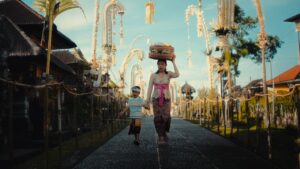

spiritual practice, and daily work exist in continuous relationship. Life unfolds through patterns
that have developed over centuries and remain active today.
Walking through a village is not only moving through space. It is moving through a structure of
beliefs, responsibilities, and rhythms that shape how people live together.
The Structure of a Balinese Village
A traditional Balinese village is organized according to spiritual orientation rather than random
development. Homes, temples, and communal spaces are positioned in relation to mountains, sea,
and sacred direction.
Each household is typically arranged as a family compound — a collection of pavilions surrounding
an open courtyard. Within each compound stands a family shrine, where daily offerings maintain
spiritual balance.
At the village level, temples serve collective worship, while open spaces function as gathering
areas for ceremonies and community events. The physical layout reflects harmony between individual
families and the wider community.
Daily Rhythm of Work and Ritual
Life in a Balinese village follows rhythm rather than strict schedule.
Morning often begins with offerings placed at shrines, entrances, and sacred points around the home.
These small gestures acknowledge balance between visible and invisible forces before daily work begins.
Work itself varies — tending rice fields, preparing food, crafting goods, maintaining homes,
or fulfilling community responsibilities. Ceremonies occur on specific days determined by the
Balinese calendar, integrating spiritual practice directly into everyday routines.
Work and ritual are not separate domains. They interweave continuously.
Community and Shared Responsibility
Village life is built on cooperation. Ceremonies, temple maintenance, and collective needs are
supported through shared participation among residents.
Responsibilities are distributed across families and generations. Participation is not optional;
it is part of belonging. Through this shared structure, traditions remain active rather than preserved
as historical memory.
Community is not simply social connection — it is the framework that sustains continuity.
The Relationship Between Land and Livelihood
In many villages, agriculture remains central — especially rice cultivation. The land is not only
a source of income, but also a sacred environment requiring respect and careful management.
Irrigation systems, planting cycles, and harvest rituals reflect an understanding that human survival
depends on maintaining balance with nature. Farming is both practical activity and spiritual practice.
The landscape shapes daily life, and daily life shapes the landscape.
Time and Continuity
One of the most distinctive aspects of village life is continuity. Generations live in the same
place, maintaining patterns established long before them.
Change occurs, but gradually. The present remains connected to the past through repeated practice —
ceremonies, offerings, community gatherings, and seasonal cycles.
Time here often feels circular rather than linear.
Understanding Bali from Within
Visitors often encounter Bali through destinations and experiences. But village life reveals
something deeper — how culture is lived moment by moment.
To walk through a village is to witness balance in motion: between work and worship, individual
and community, land and life.
Through this living structure, the deeper character of Bali becomes visible — not as performance,
but as continuity.
Explore More Destinations in Bali
If you wish to discover more places that reveal how daily life and landscape shape the experience of Bali,
continue exploring the destinations within Gangga Experience.